LONSURF alone in previously treated mCRC
LONSURF alone in previously treated mCRC
LONSURF alone was initially approved based on the RECOURSE trial.1,2
RECOURSE study design


RECOURSE was an international, randomized, double-blind, placebo-controlled, Phase 3 clinical trial.1
Inclusion criteria1-3
- Age ≥18 years
- Confirmed adenocarcinoma of the colon or rectum
- ECOG performance status (PS) of 0 or 1
- Received at least 2 prior regimens of standard chemotherapy and were refractory to or were failing all of the following within 3 months
- Fluoropyrimidine, irinotecan, and oxaliplatin
- Anti-VEGF biological therapy
- Anti-EGFR therapy (if RAS wild-type)
- Disease progression based on imaging during or within 3 months of the last administration of each of the standard chemotherapies
2:1 Randomization1
LONSURF + best supportive care
(n=534)
35 mg/m2 twice daily after meals for 5 days a week with 2 days rest for 2 weeks, followed by a 14-day rest, repeated every 4 weeks
Placebo + best supportive care
(n=266)
Twice daily after meals for 5 days a week with 2 days rest for 2 weeks, followed by a 14-day rest, repeated every 4 weeks
All patients were followed for survival at scheduled 8-week intervals with computed tomography (CT) scans until 12 months after the first dose of study medication from the last patient randomized. After the end of treatment, all patients were followed for survival at scheduled 8-week time intervals until death.3
Key baseline characteristics2
| Characteristic | LONSURF (n=534) | Placebo (n=266) | |
|---|---|---|---|
| Sex, n (%) | Male | 326 (61) | 165 (62) |
| Female | 208 (39) | 101 (38) | |
| Age (years) | Median | 63 | 63 |
| Range | 27-82 | 27-82 | |
| Race or ethnic group, n (%) | White | 306 (57) | 155 (58) |
| Asian | 184 (34) | 94 (35) | |
| African American | 4 (<1) | 5 (2) | |
| ECOG PS, n (%)* | 0 | 301 (56) | 147 (55) |
| 1 | 233 (44) | 119 (45) | |
| KRAS mutation, n (%) | No | 262 (49) | 131 (49) |
| Yes | 272 (51) | 135 (51) | |
| Time from diagnosis of metastases, n (%) | <18 months | 111 (21) | 55 (21) |
| ≥18 months | 423 (79) | 211 (79) | |
*ECOG PS is scored on a scale of 0 to 5, with 0 indicating no symptoms, 1 indicating mild symptoms, and higher numbers indicating increasing degrees of disability.
All patients received prior treatment with fluoropyrimidine-, oxaliplatin-, and irinotecan-based chemotherapy. All but 1 patient received bevacizumab, and all but 2 patients with KRAS wild-type tumors received panitumumab or cetuximab.1
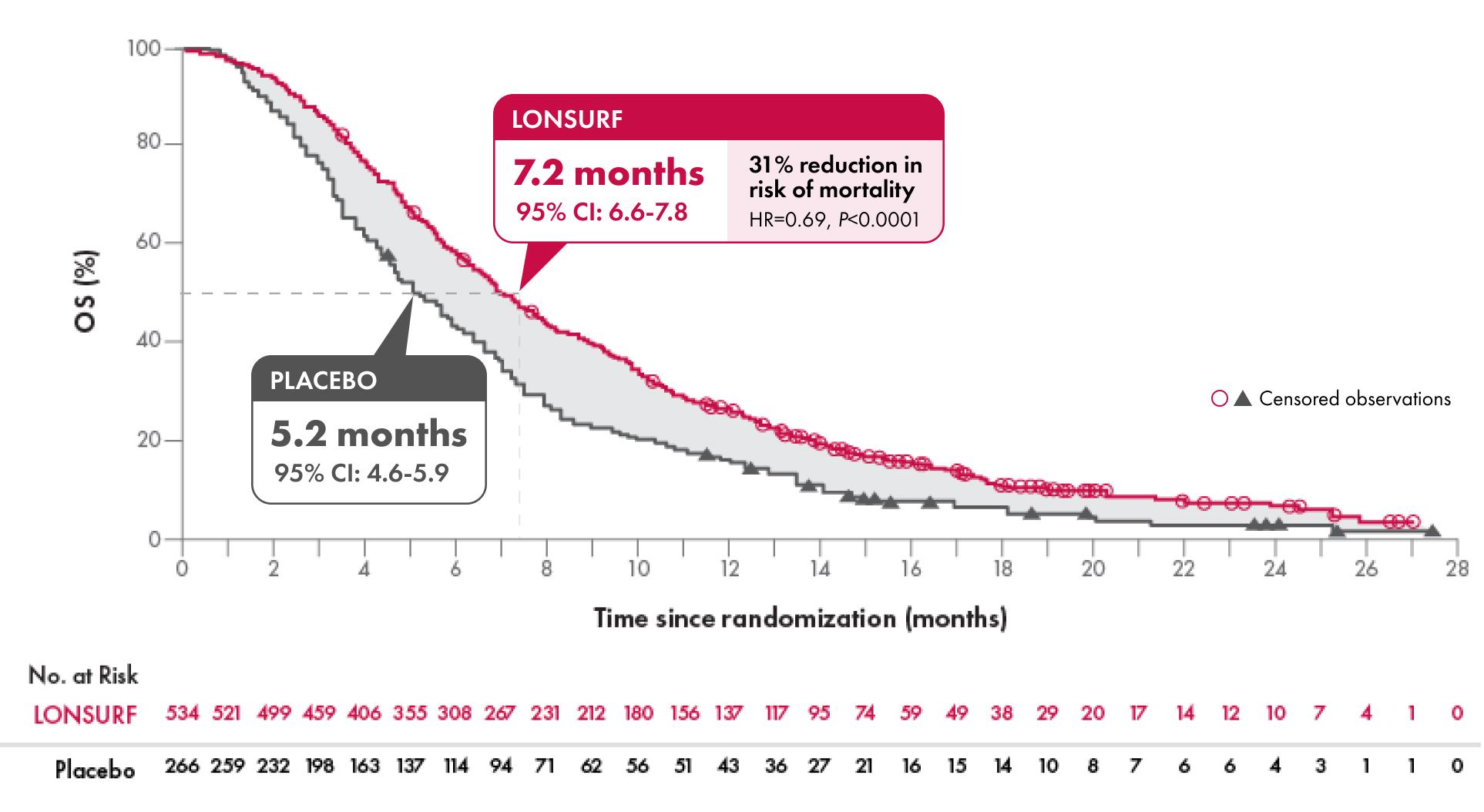
PRIMARY ENDPOINT
OS with LONSURF alone
Overall Survival (OS) (N=800)4
SECONDARY ENDPOINTS
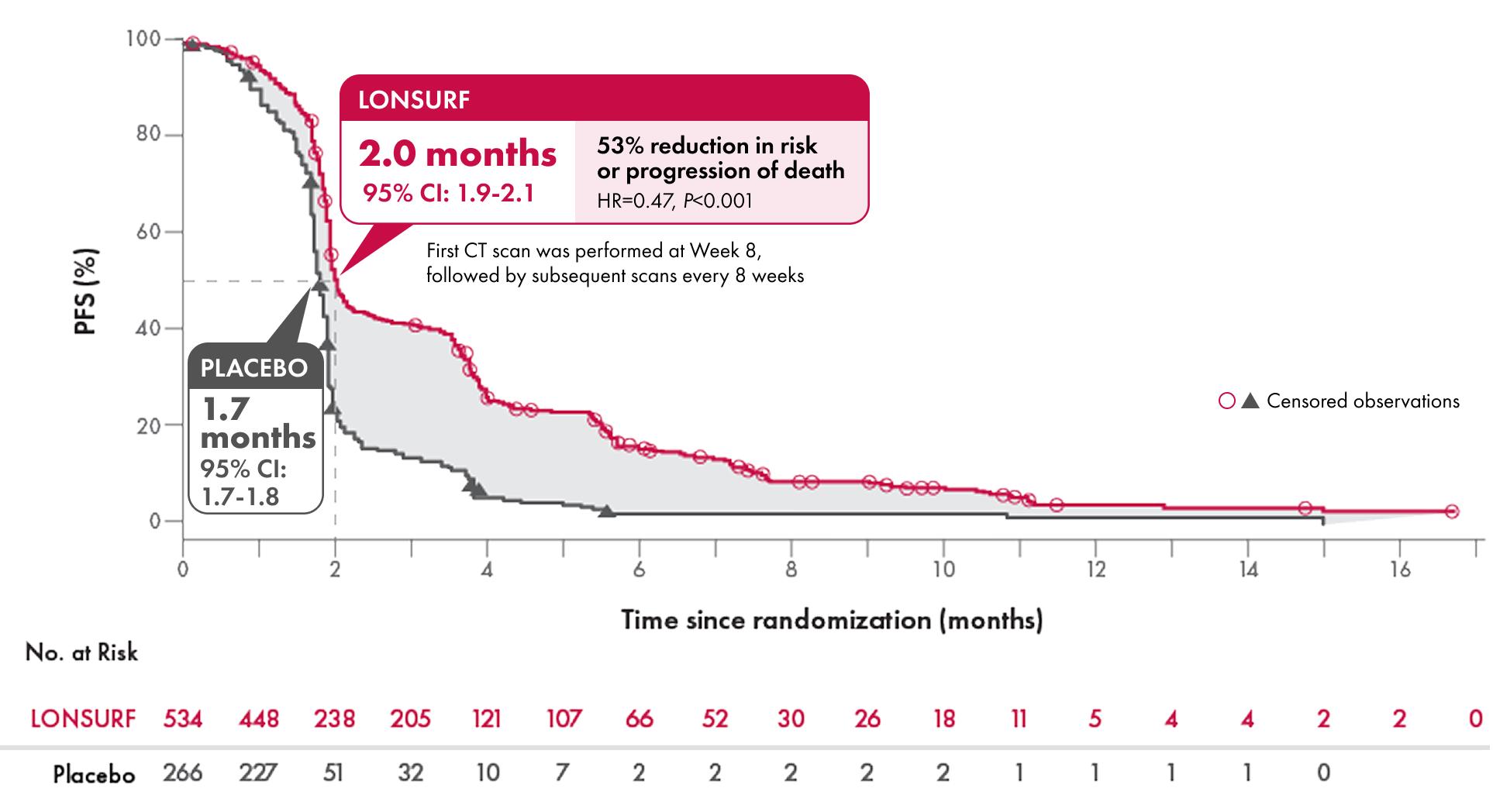
PFS with LONSURF alone
Progression-free Survival (PFS) (N=800)1-3
Disease control rate (DCR)2,3
| LONSURF (n=502) | Placebo (n=258) | |
|---|---|---|
| DCR | 44% (221) | 16% (42) |
| Complete response | 0% (0) | <1% (1) |
| Partial response | 2% (8) | 0% (0) |
| Stable response | 42% (213) | 16% (41) |
DCR=complete response + partial response + stable disease.
NCCN Guidelines® in metastatic colorectal cancer
RECOMMENDED
The National Comprehensive Cancer Network® (NCCN®) recommends trifluridine and tipiracil (LONSURF) +/- bevacizumab as NCCN Category 2A recommended options for a potential third-line or subsequent treatment in mCRC patients. The trifluridine and tipiracil (LONSURF) + bevacizumab combination is preferred over trifluridine and tipiracil (LONSURF) alone.5,6
Category 2A=based upon lower-level evidence, there is uniform NCCN consensus (≥85% support of the Panel) that the intervention is appropriate.
NCCN makes no warranties of any kind whatsoever regarding their content, use or application and disclaims any responsibility for their application or use in any way.